The National Research Council ranks the University of Rochester English Department among the best PhD programs in the country.
Chronicle of Higher Education, “2010 Rankings: Doctoral Programs in America”
Click on the image above for a PDF version of the graph.
Summer Defense Deadlines:
Registration Reminder:
When you register for graduate courses, note that all 500-level courses in the English Department carry 5 credits. In order to receive 5 credits for a 400-level course in the English Department, you will need to register for the 4-credit 400-level course AND for the proper 1-credit 400M course. You will be able to locate the proper 1-credit 400M easily: the 400M number will be identical to the 400 number for your 4-credit course (i.e., ENG 410 and ENG 410M). The instructor will explain the requirements for obtaining this extra one credit.
PhD students from any department or program who are traveling to conferences may apply to the University Dean of Graduate Studies for reimbursement of airfare and conference registration costs up to $800. Priority will be given to Sproull and Provost Fellows, and to students who are the main or sole author of the work to be presented.
The University of Rochester is a member of the Folger Institute Consortium; our faculty and students receive preference in admissions, and are eligible to receive grants-in-aid to support their travel and lodging while attending Folger Institute events. The Institute’s interdisciplinary programming immerses participants in the Folger Library’s holdings, most famous for their Shakespeare-related materials but which include hundreds of thousands of books, manuscripts, and visual objects pertaining to early modern Western culture most broadly conceived (British, Continental, American, and Transatlantic).
June 3 is the deadline for the Institute’s 2013-14 year-long colloquium “Constructing and Representing Authorship in Early Modern England,” directed by Barbara K. Lewalski; the year-long dissertation seminar “Researching the Archive,” directed by Karen Ordahl Kupperman and Peter Stallybrass; the fall 2013 seminar “Entangled Histories: Native America in Europe, 1492-1700, directed by Marcy Norton; and the fall 2013 symposium “Where Was Political Thought in England, c. 1600-1642?”
The application forms are brief and very straightforward. If you are interested in applying for Institute programs, please consult with Professor Katherine Mannheimer (katherine.mannheimer@rochester.edu), who is our university’s Folger Institute representative and whose signature is required on all applications. Details about Folger programs and the application process are available online at the Folger Institute website.
Recent graduate student recipients of Folger Institute grants-in-aid include Lisa Vandenbossche (attending the seminar “Law as Politics in England and the Empire, ca. 1600-1830,” in spring 2013), Nicholas Knopf (attending the seminar “Thinking the Revolution: American Political Thought, 1763-1789,” in spring 2012), Joseph Lamperez (attending the Folger conference “Early Modern Cites in Comparative Perspective,” in fall 2012), and Sarah Bunker (attending the year-long dissertation seminar “Researching the Archive,” throughout the 2012-13 academic year).
Congratulations to our PhD and MA recipients on these recent accomplishments in their careers and ongoing graduate studies:
As an advanced Sproull Fellow, Nikolaus Wasmoen was awarded dissertation research travel funds by the University to conduct primary source research at the Beinecke Library in New Haven and the Rosenbach Museum and Library in Philadelphia.
We are pleased to announce that Peter Zogas received a 2013 Edward Peck Curtis Award for Excellence in Teaching by a Graduate Student. Congratulations! Margaret Kearney, Vice Provost and University Dean of Graduate Studies, presented Peter with his award during a reception on April 23.
Congratulations to the recipients of the 2013-14 Dean’s Dissertation and Dean’s Teaching Fellowships, awarded by the College of Arts, Sciences and Engineering:
Dean’s Dissertation Fellowships
(for one semester in 2013-14)
Dean’s Teaching Fellowships
(for one semester in 2013-14)
Laura Bell was selected as the English Department’s participant in the Cornell School of Criticism and Theory for summer 2013. She will be attending the seminar “Dwelling | Telling | Selling: Contemporary Design Topographies,” directed by Julia Reinhard Lupton.
We’re proud to announce that the following students defended their dissertations and were awarded the PhD in English in fall 2012:
Miriam Margala, “Translation, Recognition and the Materiality of Language”
Shaila Mehra, “Recasting the Past: Historical Knowledge and the African American Postmodern”
Russell Sbriglia, “Dissensus Communis: Conservatism, Skepticism, and Sympathy in the American Renaissance”
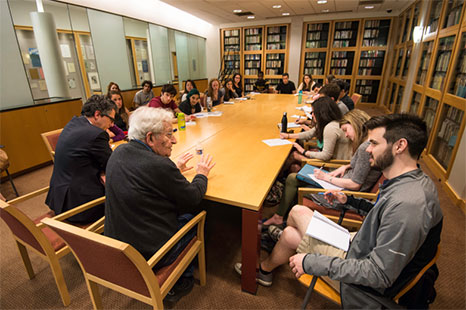
The MA and PhD programs at the University of Rochester offer students the scholarly resources and intellectual energy of a major research institution in an environment that permits close personal attention and open exchange. Graduate students interact with a faculty of active scholars and teachers whose publications and professional engagements continue to earn the English Department national and international recognition. The current English Department faculty includes six Guggenheim Fellows, a MacArthur Foundation Fellow and Pulitzer Prize finalist, as well as recipients of numerous fellowships from the National Endowment for the Humanities, the American Council of Learned Societies, the Fulbright Foundation, the National Humanities Center, the Folger Shakespeare Library, the Huntington Library, the Newberry Library, the Rockefeller Foundation, and the Mellon Foundation. The National Research Council ranks the University of Rochester English Department among the best PhD programs in the country (NRC Data Table; S-range of English programs ordered by the mid-point of the range).
The English Department is centrally committed to literary study across the full range of British and American literatures. The department has a long history of strength in medieval studies, modern literature, text editing and theory, and creative writing, and has developed more recently strengths in cultural studies and in film theory. Ours is a flexible program that encourages students to select their courses in close consultation with faculty. Graduate course offerings reflect the diversity of intellectual interests in the department—interests that include both British and American literature, as well as specifically interdisciplinary areas of scholarship such as African-American studies, cultural studies, gender studies, and film and media studies.
Most of our faculty emphasize in their research and teaching some combination of aesthetic, formal, and historical analysis. They seek to examine the ways in which works address their audiences cognitively and emotionally. These concerns include the study of how forms of imagination evolve through history; how they reflect and focus significant changes in thought, religion, politics, science, economics, and technology; how literature, film, and other media shape our narratives about the past and the present; how they amuse, disturb, or please us. Direct encounters with the work of art, practical criticism, and theoretical arguments all have a place in exploring how sensibility and taste come into being and how they relate to broader currents of thought and debate in art, ethics, politics, and society.
Although the English Department does not offer an MFA, it does offer special opportunities for qualified students to combine literary scholarship with the development of their fiction or poetry writing. Our distinguished creative writing faculty are scholars and teachers of eighteenth-century British literature, American literature, modernism, and later twentieth-century and contemporary literature. They offer graduate courses that draw on their literary scholarship, and creative writing courses that are open to graduate student enrollment. Our current fiction writers and poets include a MacArthur Foundation Fellow, a Pulitzer Prize finalist, an Assistant Director of the Bread Loaf Writers Conference, and recipients of the “Discovery” Award from The Nation, the Lannan Literary Award, the Rona Jaffe Foundation Writers’ Award, and a Translation Award from the American Translators Association.
The Hyam Plutzik Library of Contemporary Writing, which houses the William and Hannelore Heyen collection of manuscripts, broadsides, and first editions of twentieth-century poetry, a remarkable collection containing thousands of items, provides unique research opportunities. The department’s Plutzik Memorial Reading Series is coordinated with creative writing courses and courses in contemporary literature. In recent years, students have had the opportunity to interact with such notable writers as Louise Glück, Robert Pinsky, Salman Rushdie, Jorie Graham, John Ashbery, William Kennedy, Michael Ondaatje, Grace Paley, and Mark Strand.
Graduate students who combine literary scholarship and creative writing are often particularly interested in courses offered by the College’s Program in Literary Translation Studies and its internships at Open Letter. Open Letter is the University of Rochester’s literary publishing house, dedicated to connecting readers with great international authors and their works; it publishes twelve books in translation each year. The Program in Literary Translation Studies also offers a Graduate Certificate in Literary Translation that is an ideal supplement to an English Department MA or PhD; it provides hands-on experience as translators along with a theoretical background in the field of literary translation.
A number of important collaborative scholarly projects are based in the English Department, including Blake/An Illustrated Quarterly and the William Blake Archive online hypertext project (in cooperation with the University of North Carolina and the Library of Congress). The Chaucer Bibliographies series (published by the University of Toronto Press) is located in the department, as is the Middle English Text Series, published by the Consortium for the Teaching of the Middle Ages (TEAMS).
Interested graduate students have the opportunity to work with faculty on these projects and as interns with Open Letter and the Camelot Project or as curating interns in the archives of George Eastman House International Museum of Photography and Film. The Camelot Project, housed in the University of Rochester’s Rush Rhees Library and coedited by a member of the English Department faculty, makes available in electronic format a database of Arthurian texts, images, bibliographies, and basic information. George Eastman House is one of the most important film archives in the world, housing 25,000 film titles; 400,000 photographs and negatives; and three million pieces of film-related publicity stills, posters, scores, scripts, and pre-cinema artifacts.
Among the more distinctive features of the University of Rochester is its sustained commitment to research and teaching that extend across historical fields and departmental boundaries.
The English Department has a longstanding interest in editorial theory and practice—areas of significant strength for at least 50 years. Our faculty have been at the forefront of recent developments in editing, helping to illuminate the way editorial decisions involve basic issues in the nature, shape, transmission, and preservation of information.
The department’s investments in film studies, beginning in the early 1970s, and, more recently, in translation studies, digital humanities, theater, media studies, media history, and the history and theory of authorship have extended our intellectual reach. Departmental research and teaching in these areas contribute to our understanding of how different media—oral, visual, aural, dramatic, cinematic, electronic—distinctively shape the “messages” that English delivers to its audiences and how the effects of those media are inflected by changing concepts of literary property or authorial control and self-representation.
These approaches combine interests in old and new technologies with broad aesthetic, cultural, and historical concerns. Work of this kind fosters scholarship and teaching on, for example, African-American, Asian-American, and Native American narrative traditions and their place in living communities; the effect of etched, hand-colored amalgams of text and image designed by multimedia artists such as William Blake; the art and technical practice of translation in a global marketplace; the function of visual materials in medieval and early modern literature; and the prominence of the visual, both imagistic and typographic, in eighteenth-century British satire.
English Department faculty and graduate students working in these areas often find their teaching and research enriched by colleagues, courses, lectures, and conferences in Art and Art History, Film and Media Studies, History, Literary Translation Studies, Modern Languages and Cultures, and Visual and Cultural Studies; and librarians, curators, exhibits, and special collections in Rush Rhees Library.
The University of Rochester supplements the course offerings of its faculty in British Medieval, Renaissance, and Restoration studies, and in British Romanticism and British and American Eighteenth-Century studies with a number of resources for graduate students in the early fields who are interested in working within and across historical fields and departmental boundaries.
Faculty and graduate students in the early fields edit the English Department’s scholarly journals and editorial projects—Blake/An Illustrated Quarterly, the Camelot Project, the Chaucer Bibliographies series, the Middle English Text Series, and the William Blake Archive.
The University of Rochester is a member of the Folger Institute, a center for advanced study and research in the humanities which is sponsored by the Folger Shakespeare Library and a consortium of 40 universities in the U.S. and abroad. The Institute's multi-disciplinary and cross-cultural programs are conducted as gatherings of faculty and graduate students from affiliated universities. University of Rochester faculty and graduate students from Art and Art History, English, History, and Modern Languages and Cultures have participated in the Institute’s programs.
The College’s Protocluster on Pre-Modern Studies sponsors monthly lectures and seminars by visiting Medieval and early Renaissance scholars of art history, history, literature, and religion, and provides an opportunity for faculty and graduate students at the University of Rochester to gather informally for discussions with the invited speakers.
Two recent conferences sponsored by the English Department, “Robin Hood: Media Creature” and “Restoring Dryden: Music, Translation, Print,” demonstrated the intellectual richness of working across historical fields and disciplinary boundaries. “Robin Hood: Media Creature” brought together an international cohort of scholars researching a range of historical fields in American and British literature, film, and popular culture, and working in several humanities and social science disciplines. “Restoring Dryden” included musical performances, dramatic readings, scholarly presentations, and an exhibit of rare English books and musical scores from 1659-1700.
Since the early 1970s the English Department has been committed to film studies, and has continued to expand its engagements to include television and new media studies as well. English Department faculty teach graduate and upper-level courses on subjects including film genre theory, postcolonial theory of film and literature, virtual worlds and online communities, and many other courses on specific genres, directors, movements, and theoretical issues.
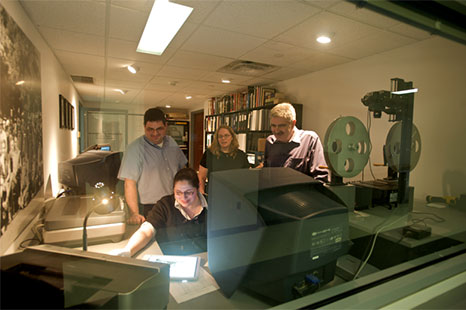
English Department faculty and graduate students engage extensively with faculty and resources from other departments and programs, including Film and Media Studies, Visual and Cultural Studies and Art and Art History, Modern Languages and Cultures, Anthropology, and the L. Jeffrey Selznick School of Film Preservation associated with George Eastman House. The first such program of its kind, the Selznick School offers a Master’s degree in preservation that also includes curatorial training, collection management, and public exhibition. Selznick School resources and events enrich the film culture available to Rochester faculty and students, and the Eastman House film archive provides valuable research opportunities. Additionally, six nights a week the Eastman House’s Dryden Theatre screens archival prints of classic and rare films, as well as rich offerings of foreign, cult, and independent cinema. The University of Rochester’s Multimedia Center, part of the River Campus libraries, holds an extensive collection of videos and film prints available for research and teaching.
Rochester graduate students curate a film series that has included the events “Walls on Film” and “Landscapes on Film,” featuring screenings of 35mm prints by filmmakers like Apichatpong Weerasethaku and Pat O’Neill. Rochester’s thriving undergraduate film culture includes an active council that organizes and promotes workshops, screenings, and other events, including a student-run festival in which participants are given twenty-four hours to conceive, shoot, and edit films that are then screened in competition. The city of Rochester also features several independent film festivals, and the Little Theatre screens current foreign and art-house cinema.
English Department faculty are active members of the University’s interdisciplinary programs, including Film and Media Studies, the Frederick Douglass Institute for African and African-American Studies, Literary Translation Studies, the Susan B. Anthony Institute for Gender and Women’s Studies, and Visual and Cultural Studies. These programs sponsor courses, conferences, lectures, research seminars, works-in-progress seminars, and reading groups that are an intellectual resource for many of our faculty and students.
Our graduate students have the opportunity to supplement their PhD with a Certificate in African and African-American Studies, a Certificate in Gender and Women’s Studies, a Certificate in Literary Translation Studies. English Department faculty are also active in the College’s Humanities Project. The College funds several proposals each year whose speakers, films, symposia, courses, conferences, panels, and exhibitions engage the research and pedagogical interests of faculty and students across the humanities.
Interested English Department graduate students benefit immensely from these interdisciplinary programs, from enrolling in courses taught by faculty in departments other than English, and from working with members of other departments who agree to serve as members of exam or dissertation committees.