
Projects for Peace
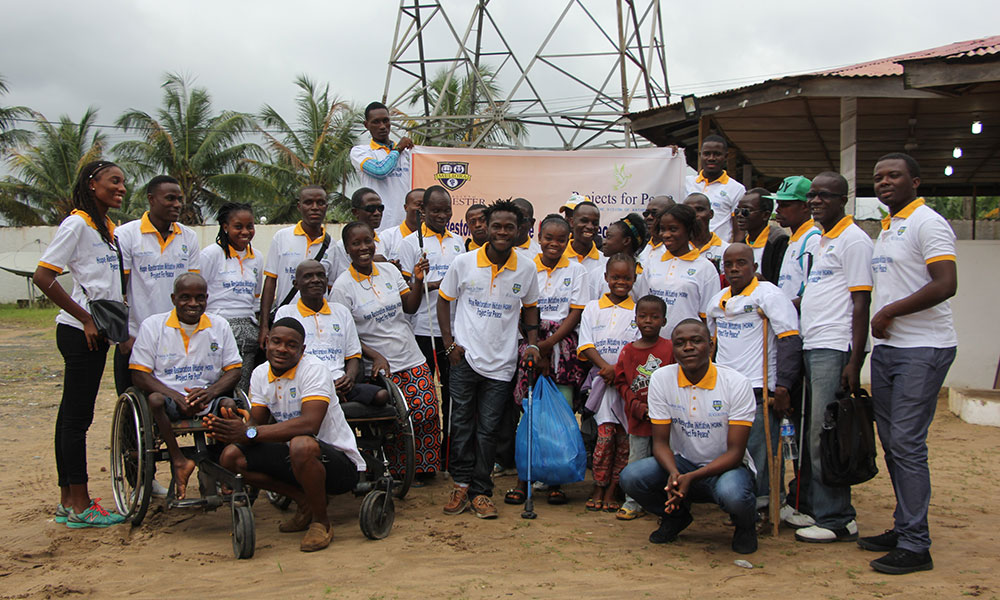
The Projects for Peace grants allow undergraduates, including University of Rochester students, to design grassroots projects focused on conflict resolution.
 Projects for Peace is a global program that encourages young adults around the world to develop innovative, community-centered responses to the world’s most pressing issues.
International philanthropist Kathryn Wasserman Davis established the program in 2007 on her 100th birthday, committing $1M for the first 100 projects. Her family has continued the commitment ever since.
Every year, 100 or more student leaders are each awarded a $10,000 grant to implement a “Project for Peace,” anywhere in the world, typically over the summer. These activities address root causes of conflict and promote peace.
As a member of the Davis United World College Scholars Program, the University of Rochester is guaranteed funding for one project annually. Proposals may be submitted by any US or international student enrolled at a partner institution.
Learn more about the Project for Peace Fellowship and other fellowship, scholarship, and award opportunities available to Rochester students.
Recent Projects for Peace Grant Recipients
Congratulations to our most recent University of Rochester Projects for Peace recipients!
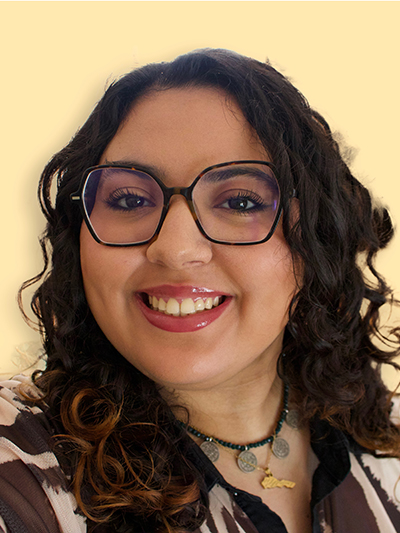
Lina Abdou ‘26
Area of study: International Relations (BA)
Minor (s): Economics and Studio Arts
Born in Troy, Ohio, Abdou was raised in Casablanca, the largest city in Morocco. From Mid-June to the end of July, Abdou will return to Casablanca for her project titled “Peace as Infrastructure: Strengthening Single-Mother Households in Morocco.” The project aims to confront the institutional practices and socio-cultural norms undergirding violence against women and create conditions where dignity, safety, and peace are possible.
“I developed this project because I’ve seen how structural inequality operates in quiet but deeply impactful ways, especially for divorced, widowed, and single mothers in Morocco,” says Abdou. “Growing up, I became aware of how these women are often expected to carry entire households while navigating economic instability, legal challenges, and social stigma, often without meaningful support. What struck me most was not just the lack of resources, but the absence of consistent, community-based systems that allow for long-term stability.”
Abdou will collaborate with Association pour l'Égalité et la Citoyenneté (ATEC). The project will include a workshop series focused on reducing exposure to conflict and building non-violent, stable ways of navigating daily life.
“When women have access to resources, knowledge, and supportive networks, they are better positioned to sustain themselves and their families,” says Abdou. “This project is my way of contributing to grounded, everyday peace, one that is built through support systems rather than imposed from the outside.”
Among her many accomplishments, Abdou received the Charles Miller Williams and Mary Washington Williams Memorial Prize from the Department of English in 2025 and received the Metro Justice "Solidarity in Action" Award in 2024.
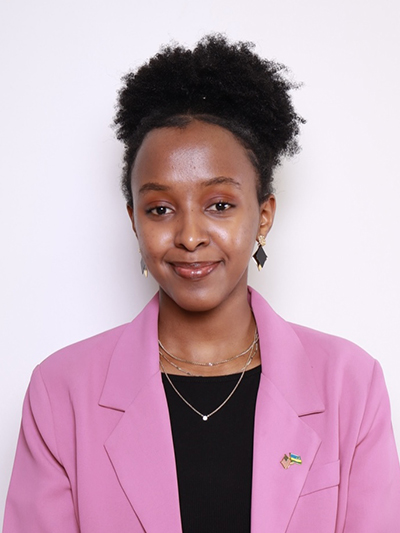
Sonia Irakoze ‘28
Area of study: Mechanical Engineering (BS)
Sonia Irakoze ’28 will return to her country-of-origin Rwanda this summer for a project titled “AquaSolve Rwanda: Solar-Powered Filtration for Peace” that aims to bring solar-powered water filtration to the Lake Mirayi area of the Bugesera District. She plans to collaborate with a local water and sanitation engineer for technical support while leading the construction and maintenance of one or two solar-powered water filtration kiosks in the Gashora sector along Lake Mirayi, a non-potable water source that many residents use despite risks of parasites, bacteria, and attacks from crocodiles.
Irakoze will work to build relationships, trust, and cooperation among wide range of stakeholders that are affected by water access issues. She plans to engage vulnerable youth, women, homeless individuals, low-income people, and local community leaders in decision making on sites of filtration kiosks, construction, management of use, and maintenance of kiosks. She will lead workshops and aims to train 10-15 “water protectors.”
“Peace is when people can live with dignity, without fear, and without having to fight for basic needs like water,” says Irakoze. “When some people drink safe water and others must risk their lives or steal to get it, there is no real peace.”
Irakoze joined URochester as a Alan and Jane Handler Scholar and has been deeply involved in student organizations including the National Society of Black Engineers, Women & Minorities in Computing, the CubeSat Club, and working as a student alumni ambassador. In the summer of 2025, she received support from the Schwartz Community-Based Internship program to serve as a development intern with the Uganda Water Project, working on data-driven outreach campaigns to raise funds for clean-water infrastructure in Uganda. This relationship will serve as a continuing source of support during her project this summer.
Past Projects for Peace Grant Recipients
2025 Recipient
Nyasha Gwaza ’26
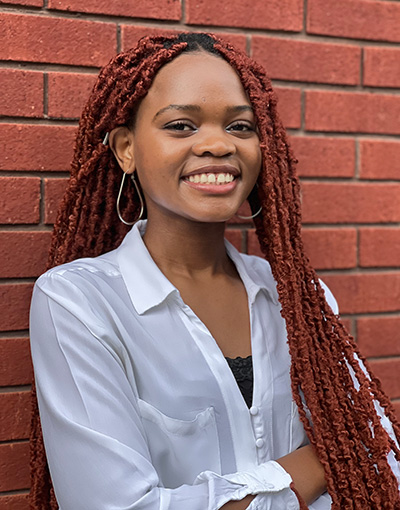
Major: Electrical and computer engineering (BS)
Gwaza came to the University of Rochester from the United World Colleges of Southern Africa, Waterford Kamhlaba high school. From May through August, she will return to her home in Gwanda, Zimbabwe for a project titled “Sewing Peace” at a local high school that she attended prior to studying at UWC Waterford.
The project’s objective is to divert young people from engaging in illegal gold panning activities and the resulting conflict with local environment management authorities, using sewing instruction as a means of socially acceptable economic self-sufficiency.
“I grew up in the Vumbachikwe and Blanket mine community, where I witnessed firsthand the devastating impact of gold panning on young people’s futures and the environment,” says Gwaza. “I chose this project because I believe that equipping youth with practical skills can break the cycle of poverty and restore dignity to communities affected by illegal mining. I hope these sewing workshops will inspire youth to choose sustainable livelihoods, rebuild their lives, and contribute to the healing of our community.”
Juliet Sullivan, the fellowships advisor in the Student Fellowships Office who coordinates the campus recruitment and nomination process for the summer grant, added “Nyasha impressed our committee with her creativity, practicality, and civic engagement, which are on full display in her Sewing Peace project.”
A highly active student at Rochester, Gwaza serves as the technical outreach and community help chair of the National Society of Black Engineers (NSBE), president of the UR Christian Fellowship, and a member of the Tau Beta Pi Engineering Honor Society. As a Schwartz Discover Grant recipient, she spent the summer of 2024 conducting research in the lab of Associate Professor Mohammad Mehrmohammadi from the Department of Imaging Sciences, and she is now a research assistant in the lab of Associate Professor Stephen Wu from the Department of Electrical and Computer Engineering.
2024 Recipient
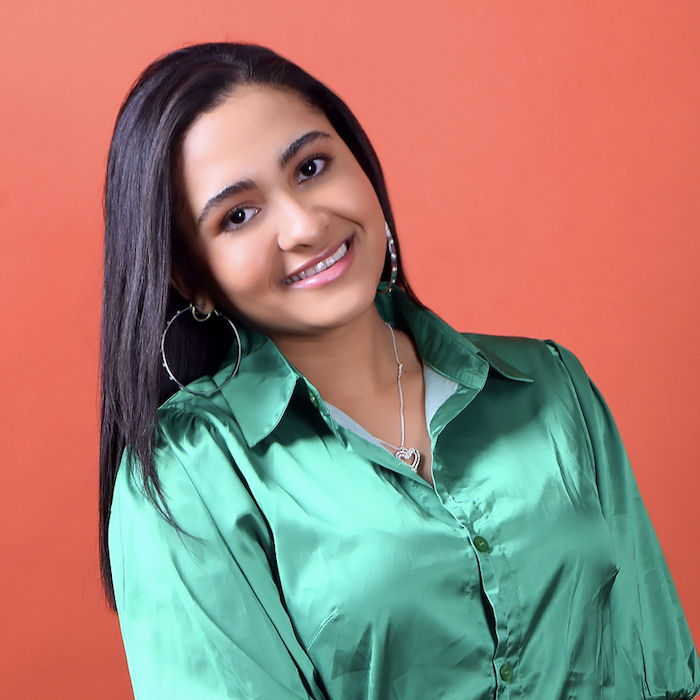
Lizmairi Vargas Santa ’26
Intended areas of study: economics (BS), business entrepreneurship (BS)
The Dominican Republic native currently lives in Dover, New Jersey. Her project, a seminar for youth titled “Fostering Curiosity and Creativity for Youth Empowerment and Lasting Peace,” will be held May 21–23 in her hometown of Azua. Around 90 high school students from that region will work in teams to generate service projects to improve their neighborhoods and schools.
“The purpose of this seminar is to foster a sense of collective effort in the community and inspire students to advocate for social change for the betterment of their future,” Vargas says. The participants, she adds, “will be exposed to challenges, networking opportunities, and professional development series to help equip students who struggle to find opportunities in their hometowns.”
Vargas is a Handler Scholar and a Kearns Center Scholar.
2023 Recipient
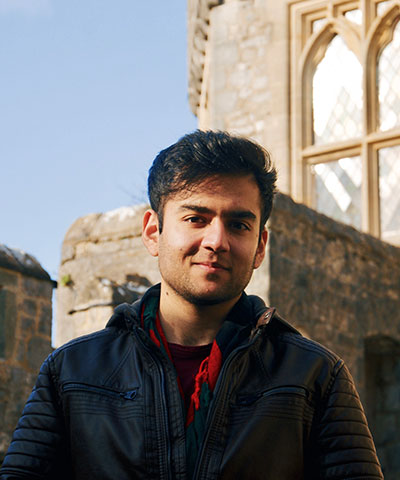
Abobakar Sediq Miakhel ’26
Intended areas of study: physics (BS) and mechanical engineering (BS)
Miakhel is an Afghan refugee who resettled in Brussels, Belgium, and attended the Davis United World College Scholars program at Atlantic College in South Wales, United Kingdom, before coming to Rochester.
He is cofounder of an app called AILEM: A Language App for Peace, which provides language education for refugees and asylum seekers hoping to integrate in a foreign country. He created it with Atlantic College classmate Xinyao Liu, who is also a refugee, in 2021. The app is free and available on the Google Play Store and the Apple App Store, with more than 6,000 downloads (primarily in Belgium, France, the Netherlands, and the UK).
“Our ethos is ‘created by refugees, for refugees,’” Miakhel says. “Every design, feature, and solution, we consult with our refugee and asylum seeker community, ensuring that we have a solution that’s tailored to their journey and experiences. We don’t see this model in other language app solutions.”
The goal of the app is to allow refugees to access necessities by using basic phrases. “In the long run, refugees can build confidence and fluency to be able to express themselves in more complex situations,” he says. “We want to make AILEM the number one solution for refugees to learn a language and integrate into society.”
The app has won several awards, including the 2023 European Charlemagne Youth Prize and the 2022 European Young Innovators Award.
Miakhel is now working on translating content into Spanish for Latin American migrants and will pivot to reaching refugees in the US this year. “To implement this plan,” he says, “we are partnering with Rochester’s Grand Challenges Scholars Program to support refugees in Utica, New York, where refugees make up a quarter of the city’s population of 60,000.”
2022 Recipients
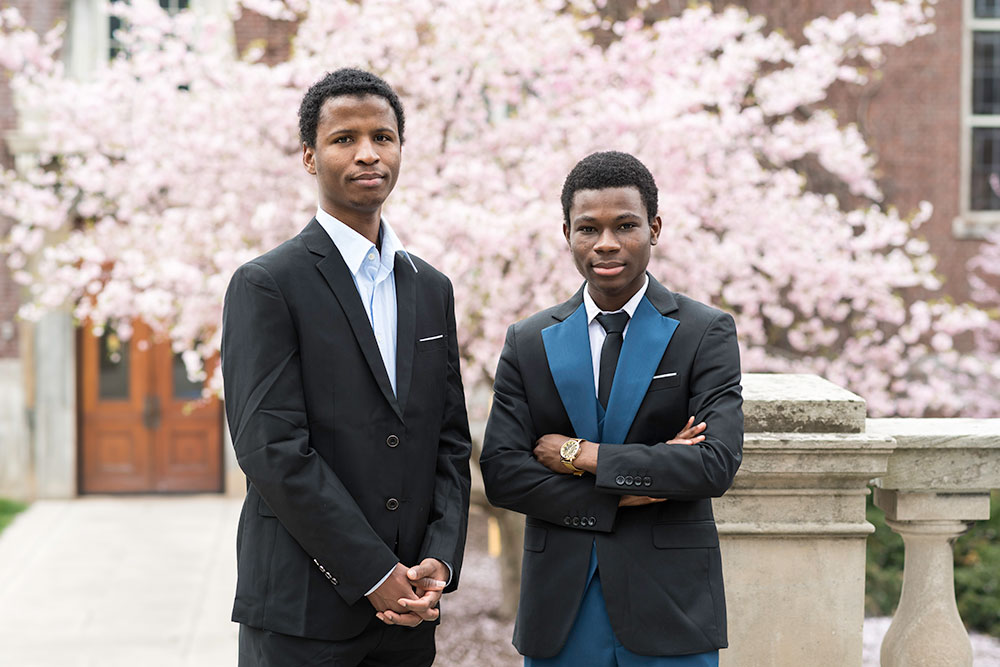
Souleymane Diallo ’24
Area of study: Politics, philosophy, and economics (BA)
Abdoul Rasmane Maiga ’25
Area of study: Computer science (BS)
Diallo is from Guinea and Maiga is from Burkina Faso, both in West Africa. Their project is called Stronger Together Initiative: A Three-Steps Approach to Heal the Hearts, Empower Women & Youths, and Unite Guinea, and will be held in Guinea from May 21 to June 4.
The project aims to promote long-term peace and reconciliation in Guinea, which has experienced numerous political instabilities, violence, and social injustices. “All have had a significant impact on the country’s development,” Diallo says. “It has left its young people in extreme poverty and despair, despite Guinea being one of the world’s richest countries in terms of natural resource endowment and population youthfulness.’’
The three-step project will include:
- A conference for Guineans of all ages and backgrounds to have an open and inclusive dialogue on the country’s history and future direction
- An entrepreneurship and leadership bootcamp that will empower 30 youths ages 15 to 25 to become proactive changemakers
- A marathon run for participants of all genders, ages, backgrounds, and ethnicities
In all, around 180 people take part in the project.
Diallo and Maiga say their project will be a stepping-stone for initiatives they are starting through their nonprofit, the Guinean Young Leaders Initiative. “With this project, we intend to positively catalyze the process of reconciliation, peace, and cohesion in Guinea,” Maiga says.
2021-2013 Recipients
2021 Recipients
Mohammed Bah ’23
Country: Central African Republic
Area of study: International relations (BA)
Minor: Computer science
Miguel Yakouma ’23
Country: Central African Republic
Area of study: Biomedical engineering (BS)
2020 Recipients
Dokata Banchale ’22
Country: Kenya
Area of study: Economics (BA)
Chernor Diallo ’22
Country: Kenya
Area of study: Economics (BA)
2019 Recipients
Beauclaire Mbanya ’20
Country: Cameroon
Area of study: Chemical engineering (BS)
Kapambwe Chalwe ’20
Country: Tanzania
Area of study: Electrical and computer engineering (BS)
Eve L. Marealle ’21
Country: Tanzania
Area of study: Mathematics (BS)
Minor: Chemical Engineering
Joyceline L. Marealle ’20
Country: Tanzania
Area of study: Chemical Engineering (BS)
2018 Recipients
Shingirai Dhoro ’20
Country: Zimbabwe
Area of study: Electrical and computer engineering (BS)
Bienfait H. Mugenza ’21
Country: Rwanda
Area of study: Political science (BA)
Philemon K. Rono ’21
Country: Rwanda
Area of study: Mechanical engineering (BS)
Ashely Tenesaca ’20 (declined)
Country: Zimbabwe
Area of study: Computer science (BS)
2017 Recipients
Emmanuel T. Gweamee ’20
Country: Liberia
Area of study: Environmental science (BS)
Aime Laurent Twizerimana ’20
Country: Liberia
Area of study: Chemical engineering (BS)
2016 Recipients
Ian S. Manzi ’18
Country: Rwanda
Area of study: Data science (BS)
Derrick Murekezi ’19
Country: Rwanda
Area of study: Geology (BS)
2015 Recipients
Eyram J. E. Adedze ’17
Country: Senegal
Areas of study: Economics (BA) and psychology (BA)
Rose N. P. N. Mbaye ’16
Country: Senegal
Area of study: Biomedical engineering (BS)
Mame Coumba Mbodji ’17
Country: Senegal
Area of study: Business (BS)
Zanga Ben A. Ouattara ’16
Country: Senegal
Area of study: Computer science (BS)
2014 Recipients
Katherine M. Wegman ’15
Country: South Africa
Area of study: Anthropology (BA) and biology (BA)
John B. Dawson ’13, ’14 (T5)
Country: South Africa
Area of study: Molecular genetics (BS)
Minors: Chemistry and psychology
2013 Recipient
Fatima R. Bawany ’16
Country: Rochester, NY
Area of study: Religion (BA) and biology (BA)